Scavland Weapon Durability: Maintenance, Repairs, and Gun Explosions
Weapon condition in Scavland from patch 0.5.169 through 0.8.0 — the 30% explosion threshold, later jams, world-loot Repair Kits, and raised wear.
FAQ
At what durability do guns explode in Scavland?
How do you repair weapons in Scavland?
What are Gun Field Tools?
Where do Expert repair recipes come from?
Did armor durability change too?
What did Update 0.7.0 change about durability?
Why does weapon condition matter so much?
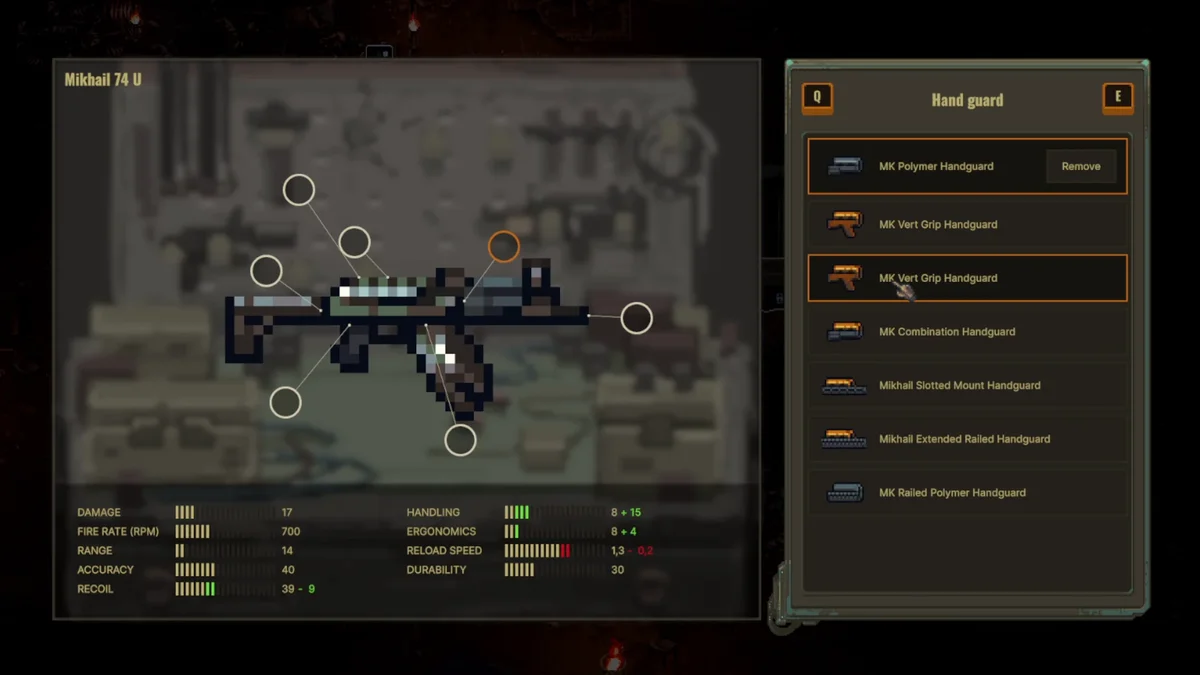
Your own weapon can be the quietest threat in a game where one fight ends a run. Condition is tracked per gun — the official Mikhail 74 U customization screenshot above shows the stat bars and part slots where that state lives — and ignoring it has an unusually loud consequence: a gun in poor condition can explode. The Day One Patch made the maintenance math friendlier:
| Maintenance change | Before 0.5.169 | After 0.5.169 |
|---|---|---|
| Gun explosion threshold | Below 50% durability | Below 30% durability |
| Armor durability loss | Baseline | Loses durability more slowly |
| Gun Field Tools | Required Gun Lube | No longer require Gun Lube |
| Heavy Armor Repair Kits | Baseline Glue cost | Require less Glue |
| Expert repair recipes | Not confirmed as drops | Can appear in Ultra Rare loot |
Update 0.6.0 (September 9) moved the numbers again, in both directions: armor durability was rebalanced downward in hit counts — Tattered 4→3, Scavenger 5→4, Medium 6→5, Heavy 7→6 hits — while Scrap-tier weapons now lose durability faster than Basic weapons (the Basic-and-above wear measured by the community at ~1% per 10 shots is unchanged in the notes). The same patch also made Expert Weapon and Heavy Armor Blueprints able to appear in end-game containers and pulled Tattered and Scavenger Armor Repair Kits out of normal world loot — they are intended to be crafted now.
Update 0.7.0 (September 16) then reversed course on the kit economy and stretched the whole timeline: weapon durability was significantly increased across almost the entire arsenal — many rifles and larger weapons now last roughly twice as many shots per durability point — jamming begins later and occurs less often (the hard-jam chance at 10% durability dropped from 45% to 33%), and Repair Kits are once again available as world loot, tiered Rare through Ultra Rare, exactly one patch after 0.6.0 pulled the low tiers out. Kits also became usable regardless of how damaged the equipment is, Glue and Gun Lube dropped from an 85% to an 80% durability floor, Cleaning Rods and Field Repair Kits from 75% to 70%, and incoming damage is now distributed across the gear pieces you wear instead of landing on one item. The same patch put Advanced/Expert kits on Volodymyr’s shelf and Medium/Heavy kits on Yefim’s — see the traders guide.
Update 0.8.0 (October 17) tightened the wear side again: wear damage from ammunition, creatures, anomalies, and explosions was raised, and clothing loses durability after fewer hits — while field repair output went the other way, with the Field Repair Kit and Cleaning Rod repair amount cut from 15 to 10. Economy-side, Armor Repair Kit blueprint prices dropped (Medium 50,000→40,000, Heavy 75,000→60,000). And armor now matters in both directions: human enemies wear it (see the ammo guide), and your own pieces take more wear per hit.
The full arsenal — 25+ weapons and 300+ customization parts across stocks, magazines, optics, muzzle devices, and grips — is covered in the weapons overview; this page is about keeping yours from detonating.
When exactly can your gun explode?
The rule is now simple: below 30% durability, the gun can explode — down from the 50% threshold the game launched with a day earlier. In practice that turns the second half of your condition bar from a danger zone into usable life: a weapon at 40% is no longer a bomb with a trigger, though the smart play is still to top it off before pushing into a bunker or the Mist.
What “explode” costs you — whether it is the gun alone, attachments, or more — is not specified in the official notes. This page will state it precisely once verified in the live game; until then, treat any worn weapon as one bad moment away from needing a replacement, and keep a backup from your Stash in mind.
How does the repair system work?
The developers confirmed a dedicated maintenance and repair system alongside the pre-launch crafting overhaul: repair recipes, tools like Gun Field Tools, and kit items like Heavy Armor Repair Kits. The Day One Patch’s ingredient cuts (no Gun Lube for field tools, less Glue for heavy armor kits) tell you the system runs on crafting materials you gather or buy — which loops repair directly into the scavenge-sell-craft economy covered in crafting and repair.
The Expert tier is where the patch opened a new door: Expert Gun and Heavy Armor Repair recipes can now appear in Ultra Rare loot, giving deep-run players a way to earn top-tier maintenance capability rather than only buying it. Where those drops live — the Mist, procedural bunkers, or elsewhere — is not documented officially yet; the procedural bunkers guide covers what is confirmed about the game’s lootable depths. Since 0.7.0 the kit ladder is readable straight from the notes: Tattered/Scrap kits drop as Rare loot, Scavenger/Basic as Very Rare, and Advanced/Expert/Medium/Heavy as Ultra Rare — with usable-at-any-damage rules removing the old “too broken to fix” cliff.
What should a maintenance routine look like?
Nothing in the official notes prescribes a routine — the list below is this wiki’s reading of the mechanics above, in the spirit of the cautious-run discipline the beginner guide teaches. Four habits cover most of what matters before you leave the settlement:
- Check condition before you leave — anything near 30% is a fuse, not a weapon.
- Carry or plan for tools — field repairs via crafted Gun Field Tools are now cheaper since the Gun Lube requirement is gone.
- Sell junk, fund repairs — Buy/Sell rates were rebalanced in the same patch (see traders), so check what your haul sells for before budgeting a repair stop
- Watch armor too — slower durability loss means less kit churn, but Heavy Armor Repair Kits still need Glue, just less of it.
Every durability-related change in this article comes from the official patch notes (0.5.169 through 0.8.0), indexed with the rest in the update tracker — if a future patch moves the explosion threshold again, both pages update with it.
Related Articles
weapons
Scavland Attachments and Ammo: Sights, Mags, and Ammo Types
Scavland packs 300+ attachments into five slot types — which guns take what (community-documented), and how ammo matches armor. Every row sourced.

guides
Scavland Bestiary: How to Beat Every Enemy (Community-Tested Tactics)
Community-tested tactics for every Scavland enemy — rats, hellhounds, rabbits, the bear Veles, Exploders, wound grass, and the Mother Rat — drops included.
weapons
Scavland Ergonomics and Handling: What the Stats Do So Far
Scavland's ergonomics and handling stats are undocumented officially — the community's working theories, headshot practice, and ammo-vs-armor matching.
Where to go next
Scavland Crafting, Repair, and Weapon Maintenance
The repair-bench half of the same problem
Scavland Mutants and Creatures: Every Enemy Confirmed So Far
Creatures got gentler in 0.5.169 — your own gun is the bigger risk now
Scavland Traders Guide: Every Confirmed Vendor and What They Sell
Volodymyr and Yefim now sell Repair Kits — the vendor directory
Was this helpful?
Thanks for the feedback!